
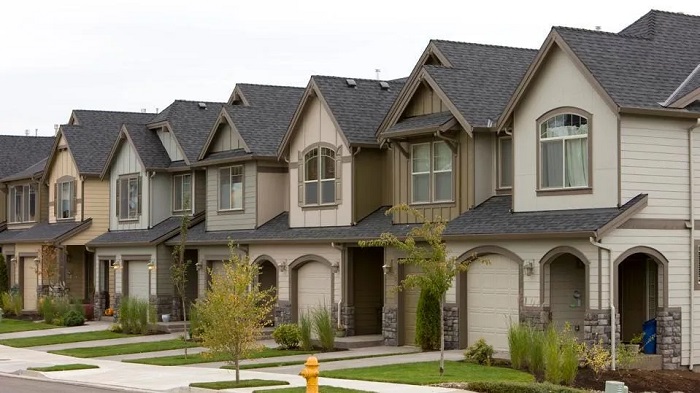
A townhouse is a housing format that combines the privacy of a detached home with the practicality of an urban apartment. It is ideal for those who wish to live closer to nature or in a quiet neighborhood, yet do not want to stray too far from essential infrastructure and everyday conveniences.
The growing popularity of townhouses stems from their successful balance of features: a private entrance, a personal terrace or small yard, efficient floor plans, and manageable maintenance costs. When a project is well-chosen and built to a high standard, a townhouse serves as an excellent long-term solution for both families and investors.
Advantages of Townhouses for Permanent Residence
The primary benefit of a townhouse is efficiency. Residents enjoy the feel of a standalone home without the excessive space and high costs often associated with a detached house. Furthermore, the sectional design allows for more precise budget planning, as buyers can easily compare options based on square footage, finishes, and the status of utility systems.
Comfort and Privacy Without Excessive Isolation
For many families, having personal space is essential—this includes having a private entrance, avoiding shared entryways or elevators, and the ability to step directly outside from the living room. At the same time, a townhouse does not isolate residents from the community; such developments often foster a friendly, neighborly environment, and it is easier for children to find friends nearby.
Efficient Layout and Flexible Use
The vertical structure allows for a logical separation of living zones: the ground floor is typically dedicated to the living room, kitchen-dining area, and utility spaces, while the upper floor houses bedrooms and home offices. Many units also include walk-in closets, laundry rooms, and storage areas, which help keep daily life well-organized.
If desired, a portion of the space can be adapted into a home office, a workshop, or a guest room.
Cost-Efficiency and Energy Performance
Shared walls create a more stable thermal envelope, while a smaller plot size reduces landscaping and site development costs. With modern construction technologies—such as high-quality windows, effective insulation, and well-designed ventilation—a townhouse can maintain a comfortable indoor climate while keeping utility costs moderate. It is essential that the project includes soundproofing solutions, particularly for the walls shared between units.
Infrastructure and Managed Property Services
In many developments, the grounds are organized as a cohesive environment, featuring parking, guest spaces, children’s play areas, lighting, cleaning services, and utility maintenance. This eases the burden of daily property management and ensures a predictable living experience. Developers across various regions—including firms like BlackRock Homes and other specialized home builders in Boise Idaho —demonstrate how the townhouse format can align with modern standards for quality and convenience.
Legal Status of a Townhouse: Registration, Address, and Residency
The legal status of a townhouse from home builders in Eagle Idaho determines whether you can fully utilize the property as a “standard home”—this includes the ability to secure unrestricted ownership, obtain a formal postal address, connect to utility services under clear, standardized terms, and register your official place of residence. In practice, what matters most is not the label “townhouse,” but rather the permitted land use and how the property is officially recorded in the Unified State Register of Real Estate (EGRN).
Before making a purchase, it is crucial to clarify exactly what is being offered: is it an individual residential unit within a row-house structure, or is it, for instance, a portion of a building or an apartment located on land designated for a different purpose?
This determines the procedure for registering ownership rights, the possibility of being assigned an official address, and the prospect of obtaining formal residential registration (a “propiska”).
Registration of Ownership, Official Addresses, and Residential Registration
1) The registration of ownership begins with a review of the documentation and the accuracy of the property’s details in the Unified State Register of Real Estate (EGRN). An ideal scenario is one where each section is registered as an individual residential house (within a row-house or “blocked” development), with a corresponding plot of land also registered (either under ownership or a legal right of use) and with clearly defined boundaries (established via a land survey).
- Check the EGRN for the following: the property’s designated purpose, its type, total area, number of floors, any existing encumbrances, and whether the actual boundaries match the data in the cadastre.
- Verify the status of the land: its category and permitted use must allow for the construction and/or operation of residential housing.
- Compare the actual layout with the technical documentation: significant discrepancies may lead to a rejection of the registration application or require a formal legalization of the changes.
2) An official address is necessary for the proper functioning of delivery services, emergency response, entering into contracts with utility providers, and obtaining formal residential registration. An address is assigned by the local municipal authority, provided that the real estate is duly registered and meets all addressing requirements.
- In an “ideal” model, each section is assigned its own distinct address (or an address that includes a specific building, block, or unit identifier, depending on the registration scheme used).
- If a property is registered merely as a “part of a building” without a full-fledged residential designation, or as a non-residential space, there may be limitations regarding the assignment of an official address, or the address itself may be assigned according to a different logic, which complicates subsequent actions.
3) Official residency registration (*propiska*) is possible only when a property has the legal status of a residential unit or residential house and has an officially assigned address. If a property is legally classified as non-residential (for example, “apartments” or premises designated for other purposes), permanent residency registration is generally not possible; in such cases, options are typically limited to other forms of registration or temporary residency, provided there are legal grounds for them.
- Ensure that the Unified State Register of Real Estate (EGRN) lists the property’s purpose as “residential.”
- Verify that an official address has been assigned (and that it is correctly reflected in all documentation).
- Clarify the registration procedures and the required list of documents for your specific region; typically, you will need proof of ownership and a formal application.
In summary: the advantages of a townhouse on Blackrock Homes are only fully realized when its legal status is clear and unambiguous. The ideal scenario is one where the unit is registered as a “residential house within a block development” (*zhiloy dom blokirovannoy zastroyki*), the land has the appropriate legal designation, both the property and the plot are entered into the cadastre, an official address has been assigned, and there are no discrepancies in the Unified State Register of Real Estate (EGRN). Under these conditions, the purchase becomes predictable, and matters concerning the address and residency registration can be resolved without unnecessary risks or wasted time.